Best Crypto Token Makers Compared in 2026
Creating a cryptocurrency token is no longer something reserved for blockchain developers.
A few years ago, launching a token could mean setting up a development environment, writing smart-contract code, configuring deployment tools, managing metadata, and figuring out how to interact with a blockchain program.
Today, crypto token makers have made the process significantly easier.
A creator can often connect a wallet, enter a token name and symbol, choose a supply, upload an image, configure token settings, and create an on-chain asset without writing code.
But that convenience creates another problem:
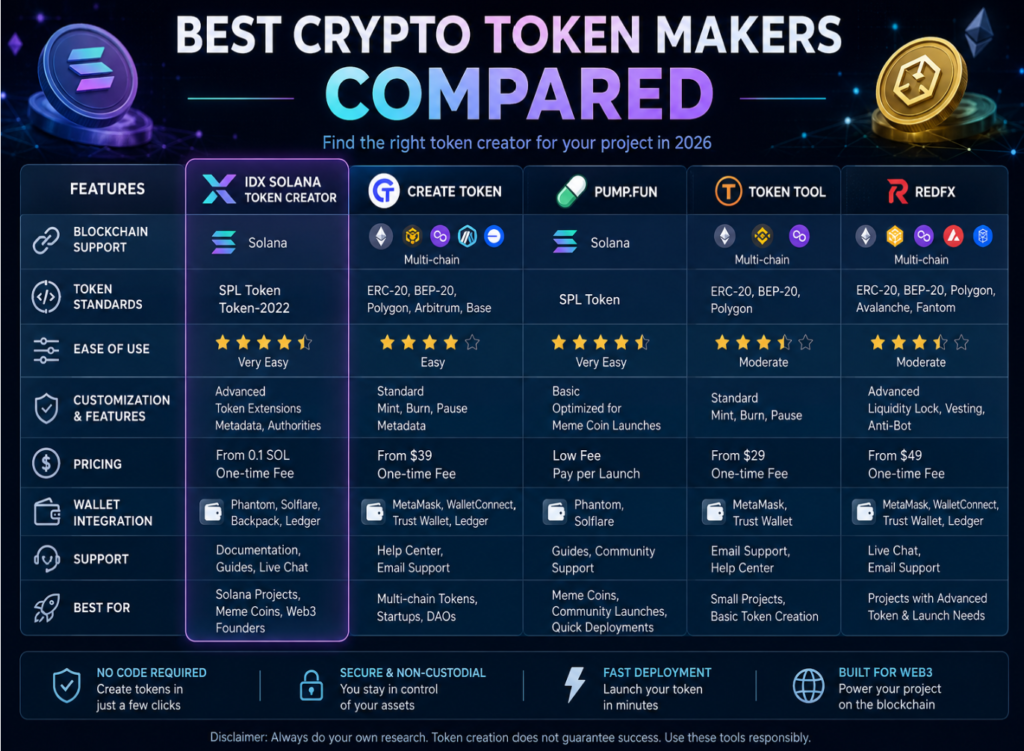
Which token maker should you actually use?
There are now many platforms offering “one-click token creation,” but they are not all built the same way. Some focus on simplicity. Others offer advanced token controls. Some support multiple blockchains, while others specialize in Solana. Some only create the token, while others attempt to provide a complete launch workflow.
This guide compares the major categories of crypto token makers and explains what you should look for before choosing one.
The goal isn’t to declare one platform universally “the best.”
The right token creator depends on what you’re building, which blockchain you’re using, how much control you need, and what you plan to do after the token is created.
Best Crypto Token Maker: The Most Important Question
There isn’t one token creator that is objectively the best for every project.
Instead, there are different categories of tools for different needs.
For a beginner: choose simplicity and transparency.
For a Solana project: choose a creator with strong Solana support.
For advanced token requirements: consider Token-2022 or custom development.
For multi-chain projects: evaluate cross-chain support carefully.
For developers: direct SDK and programmatic workflows provide the greatest flexibility.
And regardless of the platform, prioritize:
Security + transparency + control + compatibility
over flashy marketing.
Create Your Token With IDX Solana
If you’re building on Solana and want a straightforward no-code workflow, you can explore the IDX Launchlab.
The platform is designed to simplify token creation without requiring you to manually write blockchain code.
Before creating your token, decide:
- Your token name
- Symbol
- Supply
- Decimals
- Token standard
- Metadata
- Authority configuration
- Distribution strategy
Then review everything carefully before signing the transaction.
Create the token when you’re ready—not simply because the process is easy. If you wish to just start with launching a token, the answer is already there with you. But if want to dig deeper on the fact why we reached at this conclusion, you have to continue reading.
What Is a Crypto Token Maker?
A crypto token maker is a software platform that simplifies the process of creating a blockchain token.
Instead of manually interacting with blockchain programs or writing smart-contract code, the platform provides a user interface for configuring the token.
Depending on the blockchain and platform, you may be able to configure:
- Token name
- Token symbol
- Total supply
- Decimals
- Token logo
- Description
- Metadata
- Mint authority
- Freeze authority
- Transfer rules
- Token extensions
- Initial distribution
The platform then prepares the necessary blockchain transactions for your wallet to approve.
In simple terms:
A token maker turns a technical blockchain deployment process into a guided configuration workflow.
That doesn’t mean the token is centralized.
If the platform uses wallet-signed blockchain transactions, the resulting token can still exist directly on the public blockchain.
Why Are Token Makers Becoming Popular?
The biggest reason is simple:
The demand for tokenization has expanded beyond blockchain developers.
Today, tokens can be used for:
- Community projects
- Meme coins
- Gaming
- Loyalty programs
- DAO ecosystems
- DeFi applications
- Stablecoins
- Real-world assets
- Fundraising
- Rewards
- Digital memberships
- In-app economies
Solana’s token infrastructure, for example, supports standard fungible tokens as well as Token Extensions that add additional functionality. Solana’s documentation notes that Token-2022 extensions can provide features such as transfer fees, non-transferability and other token-level controls. (Solana)
That creates room for both simple and sophisticated token creation tools.
Crypto Token Maker vs Writing a Token Yourself
Before comparing platforms, it helps to understand what you’re actually paying for.
A developer can create a token directly using blockchain SDKs, command-line tools, or programming frameworks.
A token maker packages many of those steps into an interface.
| Approach | Coding Required | Control | Difficulty | Best For |
| No-code token maker | Usually no | Medium–High | Low | Beginners and founders |
| CLI tools | Some technical knowledge | High | Medium–High | Developers |
| SDK/programming | Yes | Very high | High | Custom applications |
| Full custom smart contract/program | Yes | Maximum | Very high | Advanced protocols |
The key tradeoff is straightforward:
No-code tools reduce complexity. Custom development increases flexibility.
What Should You Look for in a Crypto Token Maker?
Don’t choose a token creator simply because its homepage says “Create Token in 30 Seconds.”
Look deeper.
A good token maker should make the important decisions visible instead of hiding them.
Here are the factors that matter most.
1. Blockchain Support
The first question is:
Which blockchain do you want to create your token on?
Popular ecosystems include:
- Solana
- Ethereum
- BNB Chain
- Base
- Polygon
- Avalanche
- Arbitrum
- Other EVM-compatible networks
A platform specializing in one blockchain may provide better support for that ecosystem than a generic multi-chain platform.
For example, Solana’s native token architecture differs from Ethereum’s ERC-20 model.
So don’t assume that a token creator supporting ten chains provides the same depth of functionality on every chain.
Solana Token Makers
Solana has become particularly attractive for creators looking for fast and relatively inexpensive token transactions.
Its token infrastructure supports standard SPL tokens and the newer Token-2022 program with extensions. (Solana)
A Solana token creator may allow you to configure:
- Token name
- Symbol
- Supply
- Decimals
- Mint authority
- Freeze authority
- Metadata
- Token-2022 extensions
For creators building meme coins, community tokens, gaming assets, or other Solana-based projects, a specialized Solana token maker can be more convenient than a generic multi-chain platform.
Ethereum Token Makers
Ethereum token creation generally revolves around the ERC-20 standard for fungible tokens.
Ethereum has an enormous developer ecosystem and extensive tooling.
However, transaction costs can vary significantly depending on network conditions and whether you’re using Ethereum mainnet or an L2.
Ethereum’s biggest advantage isn’t necessarily simplicity.
It is the size and maturity of its ecosystem.
For projects that require extensive smart-contract integration, Ethereum or an Ethereum-compatible network may be a strong choice.
EVM Token Makers
EVM-compatible token creators can be useful when you want to deploy similar token concepts across networks such as:
- Ethereum
- BNB Chain
- Base
- Polygon
- Avalanche
- Arbitrum
The advantage is flexibility.
The disadvantage is that a generic platform may provide fewer specialized features for any individual chain.
2. Token Standards Matter
A token maker should clearly explain which token standard it creates.
This is more important than many beginners realize.
For example:
Solana: SPL Token / Token-2022
Ethereum: ERC-20
BNB Chain: BEP-20
These standards aren’t interchangeable.
They define how tokens interact with the respective blockchain’s infrastructure.
SPL Token vs Token-2022
On Solana, Token-2022 is particularly interesting for projects that need functionality beyond a basic token.
Solana describes Token Extensions as optional features that can be initialized on token mints or token accounts. Importantly, many extensions cannot simply be added later, so the token’s requirements should be considered before creation. (Solana)
That creates an important rule:
Choose your token architecture before you launch, not after users start trading it.
3. Supply Controls
A good token maker should clearly show how token supply works.
You should understand:
- Initial supply
- Maximum possible supply
- Mint authority
- Whether more tokens can be created
- Whether supply can be burned
On Solana, the mint account contains important token configuration, including decimals and authorities. The official documentation also describes authority changes and token burning as core token operations. (Solana)
This matters because:
A 1 billion token supply with no future minting capability is very different from a 1 billion token supply where the issuer can continue minting.
4. Authority Management
This is one of the most important features to evaluate.
For Solana tokens, look at:
Mint Authority
Can additional tokens be minted?
Freeze Authority
Can token accounts be frozen?
Update Authority
Can metadata be changed?
A token maker should explain these settings before you sign the transaction.
If it simply says:
“Make your token trusted!”
without explaining what the underlying authorities do, that’s a warning sign.
5. Metadata Support
A token isn’t just a name and a supply.
Users also expect wallets and applications to display:
- Logo
- Name
- Symbol
- Description
- Website
- Social links
Metadata infrastructure is therefore an important part of token creation.
Metaplex documentation describes metadata associated with Solana fungible assets and provides tooling for creating tokens with custom names, symbols, metadata, images, decimals, and initial supply. (Metaplex)
This means a token creator should ideally make metadata configuration straightforward.
6. Wallet-Based Signing
One of the biggest security considerations is who controls the transaction.
A strong non-custodial workflow should allow your wallet to approve blockchain transactions directly.
You should never need to give a token creator:
Your seed phrase.
Your private key.
Your wallet recovery phrase.
If a platform asks for those credentials, stop.
A legitimate wallet-based workflow should allow the wallet to show you what you’re signing.
7. Pricing Transparency
Don’t only compare the headline price.
Look at the total cost.
A token creator may charge separately for:
- Token creation
- Metadata
- Authority revocation
- Token-2022 features
- Liquidity pool creation
- Token minting
- Additional tools
For example:
Platform A: “0.1 SOL”
may become considerably more expensive after optional features are added.
A better comparison is:
What will I actually pay for the configuration I need?
Best Crypto Token Makers: What Each Type Does Best
Instead of blindly ranking every platform from #1 to #10, it’s more useful to compare them by use case.
| Token Maker Type | Best For | Main Advantage | Main Limitation |
| Solana-focused no-code creator | Solana projects | Deep ecosystem specialization | Usually single-chain |
| Multi-chain token creator | Multiple networks | Cross-chain flexibility | May have fewer chain-specific features |
| Launchpad | Meme/community launches | Token + launch workflow | Less control over custom configuration |
| Developer SDK | Developers | Maximum flexibility | Requires coding |
| CLI-based tools | Technical users | Direct blockchain control | Higher learning curve |
| Full token launch platform | Projects needing infrastructure | Creation + launch tools | More complexity |
Top Crypto Token Maker Categories in 2026
1. Solana-Focused Token Creators
Best for: Solana token launches
A dedicated Solana token creator is often the easiest option for creators who have already chosen Solana.
The advantage is specialization.
Instead of trying to support every blockchain, the platform can focus on:
- SPL tokens
- Token-2022
- Solana wallets
- Metadata
- Solana authorities
- Solana transaction flows
For a creator launching a Solana meme coin or community token, this can be more useful than having dozens of unrelated chain options.
2. Multi-Chain Token Creators
Best for: Teams planning multiple networks
Multi-chain platforms are useful when your project needs tokens across several ecosystems.
For example, a project might initially launch on Base and later expand to BNB Chain or Polygon.
The main advantage is convenience.
However, investigate whether the platform supports the native token standard and features you actually need on each network.
“Supports 20 blockchains” sounds impressive.
It doesn’t necessarily mean:
“Provides advanced functionality on 20 blockchains.”
3. Meme Coin Launch Platforms
Best for: Rapid community launches
Some platforms combine token creation with launch mechanics.
These can be attractive to meme coin creators who care more about getting a token into a market quickly than configuring every technical parameter.
But convenience comes with tradeoffs.
You may have less control over:
- Supply mechanics
- Distribution
- Liquidity design
- Token configuration
- Launch mechanics
Before using one, understand exactly what happens to the token after creation.
4. Developer Tools and SDKs
Best for: Developers and technical teams
If you’re building a serious application around your token, a no-code token maker may eventually become limiting.
Developers can use official blockchain SDKs and frameworks to create custom token workflows.
This provides much greater control.
For example, Solana provides documentation covering token creation, token accounts, minting, transfers, authority management, and burning. (Solana)
The downside?
You need technical expertise.
How We Would Compare Token Makers
Rather than ranking based purely on marketing claims, evaluate platforms using these criteria:
Ease of Use — 20%
Can a beginner understand the workflow?
Token Features — 20%
Does the platform provide the token controls you actually need?
Security — 20%
Does it use wallet-based signing? Are transactions transparent?
Pricing — 15%
Is the total cost clear?
Metadata — 10%
Can you properly configure your token identity?
Blockchain Compatibility — 10%
Does the resulting token work with the ecosystem you intend to use?
Documentation — 5%
Does the platform explain what you’re signing?
This approach is more useful than simply choosing whichever website claims to be “the #1 token creator.”
A Practical Comparison for Different Users
| User | Best Choice |
| Complete beginner | Simple no-code token creator |
| Solana meme coin creator | Solana-focused token maker |
| Multi-chain startup | Multi-chain creator |
| Developer | SDK / CLI |
| DeFi project | Custom development + token infrastructure |
| Gaming project | Token creator + custom application |
| Enterprise tokenization | Token-2022 or equivalent infrastructure with compliance controls |
| Community experiment | Simple no-code creator |
What About Token Launchpads?
A token maker and a launchpad aren’t the same thing.
Token Maker
Creates the token.
Launchpad
May help with:
- Token distribution
- Fundraising
- Launch mechanics
- Liquidity
- Community participation
Think of it this way:
A token maker creates the asset. A launchpad helps bring the asset to market.
Some modern platforms combine both.
That can be convenient, but you should understand which parts of the process you’re actually delegating.
Token Creation vs Liquidity
Another common misconception is:
“If I create a token, it will automatically be tradable.”
Not necessarily.
Creating a token establishes the blockchain asset.
It doesn’t automatically create a healthy market.
If you want decentralized trading, you generally need an appropriate liquidity mechanism and trading venue.
That means token creation and liquidity are separate steps.
Why Liquidity Matters
Imagine creating:
1,000,000 XYZ tokens
but putting almost no assets behind the trading pair.
A small buy or sell could move the market significantly.
That’s because liquidity and trading volume are different things.
Liquidity
Capital available to facilitate trades.
Volume
The value of trades executed during a specific period.
A token creator should therefore not be evaluated solely on what happens during the creation transaction.
Think about the entire lifecycle:
Create → Distribute → Provide Liquidity → Trade → Manage → Grow
No-Code Does Not Mean No Risk
This is perhaps the most important lesson in the entire comparison.
A no-code tool can remove the need to write code.
It cannot remove:
- Market risk
- Smart-contract risk
- Wallet security risk
- Liquidity risk
- Regulatory risk
- Operational risk
- User error
For example, entering:
1,000,000,000
instead of:
100,000,000
could fundamentally change your token distribution.
The interface makes creation easier.
It doesn’t make decisions for you.
Common Mistakes When Choosing a Token Maker
Mistake 1: Choosing Based Only on Price
The cheapest creator isn’t automatically the best.
A tool costing slightly more may provide better authority management, metadata support, or documentation.
Mistake 2: Ignoring the Token Standard
Don’t create a token first and figure out the standard afterward.
Determine what your application needs.
Mistake 3: Not Understanding Authorities
Know who can mint, freeze, or update your token.
Mistake 4: Giving Away Your Private Key
Never do this.
Use wallet signing.
Mistake 5: Assuming the Token Is Automatically Listed Everywhere
Creating a token doesn’t guarantee that every wallet, DEX, tracker, or exchange will display it immediately.
Mistake 6: Confusing Token Creation With a Token Launch
The token is only one component of the project.
Mistake 7: Ignoring Metadata
A token with broken or incomplete metadata looks unfinished and can create unnecessary confusion.
A Simple Token Creation Workflow
A typical no-code process looks like this:
Choose Blockchain
↓
Select Token Standard
↓
Enter Token Name
↓
Enter Symbol
↓
Set Supply
↓
Choose Decimals
↓
Upload Logo
↓
Configure Metadata
↓
Review Authorities
↓
Connect Wallet
↓
Sign Transaction
↓
Token Created
This simplicity is precisely why token makers have become so popular.
When Should You Use a No-Code Token Maker?
A no-code token creator is a strong option if:
- You don’t have blockchain development experience.
- You’re launching a standard token.
- You want to move quickly.
- You understand the configuration options.
- You don’t need custom token logic.
- You want to control deployment from your wallet.
When Should You Hire a Developer?
Consider custom development if your token needs:
- Complex transfer rules
- Custom staking
- Governance
- DeFi mechanics
- Automated distributions
- Advanced access controls
- Gaming integrations
- Custom smart contracts/programs
- Complex treasury infrastructure
In these cases, a token maker can still be useful for prototyping, but it may not be enough for the complete product.
Why Token-2022 Could Matter in 2026
Token-2022 is particularly relevant for projects that need functionality beyond basic token transfers.
Solana’s Token Extensions framework provides optional features that can be configured during token or account initialization. Some extensions have compatibility restrictions, and many cannot simply be added after initialization. (Solana)
That makes planning important.
For example, a project may eventually require:
- Transfer fees
- Non-transferable tokens
- Transfer hooks
- Permanent delegates
- Confidential transfers
- Other token controls
If you know you need advanced functionality, don’t select a basic token architecture simply because it is the fastest option.
Developer Note: Plan Before You Mint
One of the biggest mistakes developers can make is treating token creation as an isolated transaction.
Instead, design the entire lifecycle:
Token Standard
↓
Supply
↓
Authorities
↓
Metadata
↓
Distribution
↓
Liquidity
↓
Application Integration
↓
Monitoring
↓
Governance / Administration
This is particularly important with Token-2022 because extensions can have initialization requirements and compatibility considerations. (Solana)
Investor Note: Don’t Judge a Token by Its Creator
Knowing which token creator was used tells you very little about whether the project is good.
If you’re evaluating a token, focus on:
- Mint address
- Supply
- Holder distribution
- Liquidity
- Authority configuration
- Token standard
- Team allocation
- Community activity
- Trading conditions
- Project transparency
A token created with an expensive platform can still be a bad project.
A token created using a simple no-code tool can still become useful.
The tool creates the token. The project creates the value.
How to Choose the Right Crypto Token Maker
Use this five-question test.
Question 1
Which blockchain do I need?
Don’t start with the token maker.
Start with the blockchain.
Question 2
What token standard do I need?
Simple SPL?
Token-2022?
ERC-20?
Something else?
Question 3
What controls do I need?
Supply?
Authorities?
Transfer rules?
Extensions?
Question 4
What happens after creation?
Will you need:
- Liquidity?
- DEX integration?
- Distribution?
- Analytics?
- Token management?
Question 5
Can I verify exactly what I’m signing?
If the answer is unclear, don’t rush.
Frequently Asked Questions
1. What is the best crypto token maker in 2026?
There is no universally best token maker. The right choice depends on your blockchain, token standard, required features, security expectations, budget, and whether you need additional launch infrastructure.
2. Can I create a cryptocurrency token without coding?
Yes. No-code token creators allow users to configure and deploy many standard tokens without manually writing blockchain code.
3. What is the best token creator for Solana?
For Solana projects, a Solana-focused token creator can be useful because it can provide workflows tailored to SPL tokens, Token-2022, Solana wallets, metadata, and authority management.
4. What is the difference between a token creator and a launchpad?
A token creator primarily creates the blockchain asset. A launchpad may provide additional functionality for distribution, fundraising, liquidity, or launching the token to a market.
5. Does creating a token automatically create liquidity?
No. Token creation and liquidity are separate processes. A token can exist on-chain without having an active liquidity pool.
6. What is Token-2022?
Token-2022 is Solana’s Token Extensions Program. It provides optional token and account extensions that add functionality beyond basic token operations. (Solana)
7. Should I use a multi-chain token creator?
A multi-chain creator can make sense if you genuinely need tokens on multiple networks. If you’re building exclusively on Solana, a specialized Solana platform may provide a more focused experience.
8. Is a no-code token creator safe?
A no-code interface can reduce technical complexity, but it doesn’t automatically make a project safe. Always verify the platform, review transactions, protect your wallet, and understand the authorities and permissions associated with the token.
9. Can I change my token supply after creation?
This depends on the token standard and authority configuration. On Solana, the mint authority controls the ability to mint additional tokens. If that authority is revoked, additional minting is no longer available through that authority. (Solana)
10. Can I change token metadata later?
Metadata can be updateable depending on how the token and metadata authorities are configured. Token creators should therefore explain who controls metadata and whether those permissions can be revoked. (Metaplex)
11. Do token makers create smart contracts?
It depends on the blockchain. Some token standards rely on established token programs rather than requiring every project to deploy an entirely new custom contract. Solana’s standard token infrastructure is an example of this architecture. (Solana)
12. Should investors care which token creator was used?
Usually, not very much. Investors should focus on the token’s actual on-chain characteristics, including supply, holder distribution, liquidity, authorities, and project transparency.
Key Takeaways
- A crypto token maker simplifies blockchain token creation through a guided interface.
- No-code doesn’t mean no responsibility.
- The blockchain and token standard should be selected before choosing the tool.
- Solana offers standard SPL token infrastructure and Token-2022 extensions.
- Token supply and authority configuration are critical decisions.
- Metadata determines how your token is represented across applications.
- Wallet-based signing is an important security characteristic.
- Compare the total cost, not just the advertised creation fee.
- A token creator does not automatically create liquidity or market demand.
- Token makers are excellent for standard deployments but may not replace developers for complex applications.
- The “best” token creator depends on your project’s actual requirements.
- For Solana creators, a specialized no-code platform can provide a simpler path from configuration to deployment.


